Friday, December 28, 2012

How To Meditate, Part 2: Beware the Dark Side

Hopefully, my last post left you with good tips which you've been able to utilize to unlock your great inner potential. Perhaps you've discovered on your own some of the extra levels of consciousness I'll be discussing here.  I'll give you some more tips to help maximize the benefits of your meditation, but I'll also be bringing more warnings -- if the subtitle didn't clue you in.

Of course, I can't go on without my standard disclaimer: do NOT believe a word I write here. Find out for yourself! The Internet and your local library will contain all of the sources from which I have gleaned my wisdom, and you can read all about it. But my wisdom is not your wisdom -- not yet, not until you have experienced for yourself the knowledge from which that wisdom is constructed.

As an additional disclaimer, I have to mention that my experience will hopefully not be your experience. I've led a hard life, and it shows in the physical and emotional scars I bear. The reason I write these advice blogs is so that you can learn something from the hard lessons I have learned so that you might avoid the same hardships and become wiser. But this will only work if you heed my words and THINK on them earnestly. "Those who can, do. Those who have done, teach."

"Yer off the edge of the map, mate. Here there be monsters!"
-- Captain Hector Barbossa, Pirates of the Caribbean: The Legend of the Black Pearl

Human consciousness is composed of many overlapping layers. As you progress in your meditation efforts, you will discover these. (In high school, I conducted extensive research into neuroscience, and discovered scientific evidence backing this up. I might write more about that in the future.) As mentioned in the first part, awareness of self begins with the body. For most people, this awareness never goes beyond appearance, such as hair, makeup, clothes, et cetera. I highly recommend taking up a martial skill, such as karate or tae kwon do, or another physical discipline such as tai chi chuan or yoga, to increase your awareness of your body. The movement of your muscles and joints is coordinated by the cerebellum, the second-most ancient part of the brain. The most ancient part, the brain stem, controls your breathing, which is the most important discipline to practice. Working on your breathing will eventually give you access to the spinal column and reflexes, which can be better developed through the movement-based disciplines mentioned above. I can't really describe exactly what you need to do to accomplish this, but you will learn it with practice. There are far better guide books available elsewhere.

Beyond the physical level is the awareness of the emotions. This can be a very frightening level to plumb. Emotional awareness is a skill seldom taught in modern society, so when you begin to meditate on your feelings, you'll likely be straying into uncharted territory. "Here be dragons." As mentioned previously, you must not be afraid of this. Be prepared to feel fear, anger, depression, and other undesirable emotions as you replay scenes from your life, and allow yourself to feel those emotions. By experiencing them mindfully, you will begin to see how they work, and learn to control them. The carefully controlled environment of your meditation sessions are the best place to begin this awareness, but it will help if you can carry this mindfulness into your everyday life and examine your emotions as you experience them in situ. I can attest to the tremendous utility of this skill, as I've mastered my innate passion which so often expressed itself in uncontrollable rage.

I must point out that controlling your emotions is not the same as suppressing them. Suppression of emotion is incredibly unhealthy. The emotions are always lurking just below the surface of your consciousness, and the tendency is to brush them aside as you focus on the task at hand. This can work to a point, but emotions have energy, and that energy, when crushed back on itself through suppression, can build pressure ever higher until finally the emotions unleash themselves in a flood. Negative emotions are the ones most often suppressed, so this uncontrolled ecstasy of passion will likely be one of anger or sadness. The idea is to master your emotions or they will master you. This is part of the "dark side" of which is so often spoken in Star Wars lore. When you allow your emotions to run unchecked, you become enslaved by them, and your life will be subject to their random whims. Master them, the way you master your body through martial discipline, or your intellect through careful study.


"Luminous beings we are, not this crude matter!"
-- Yoda, Star Wars: The Empire Strikes Back
Speaking of the intellect, this is the next layer of your consciousness to explore, and one of the most important. Through the intellect, you grasp the physical world, master the tumultuous storm of your emotions, and begin to contemplate the higher mysteries. As you meditate, thoughts and images will float through your consciousness. Observe them, follow trains of thought, and see where they lead. Be mindful of the process by which your brain conducts these thoughts.

And be patient. Another path to the "dark side" is trying to rush your progress and get to that "spiritual center" you so desire. It is a noble goal, but it can only be reached by patient practice. Carefully manage your expectations. I've been practicing meditation for over a decade, and only just now feel competent enough to write this beginner's guide. You must manage your expectati8ons carefully and build up to loftier goals. Starting out, you'll likely spend at most a handful of minutes in meditation before the noise of your mind overwhelms you and you are forced to give up. But do not let that discourage you. Keep at it. The more you practice, the easier it will get to quiet your mind and begin to perceive the deeper parts of your consciousness. Trying to rush the process will only discourage you faster and instill a greater sense of hopelessness.

To exercise your intellect, try to make time for activities that make you think. Remember that there are two halves to your intellect, the analytical side and the creative side. My favorite simple analytical activites include crosswords and Sudoku, and I exercise my creativity with writing and sometimes drawing. Find what works best for you. Sometimes I get urges to study complex mathematics or bioenergetics. But I'm a science nerd, so such studies may not benefit you quite so much. Be bold and stretch the limits of your abilities. Do hard stuff. You'll find that your limitations melt away and you will be smarter and more capable as time goes on.

Filling your mind with intellectual pursuits will create more thought trains of increasing complexity. Observe them carefully. As time goes on, you'll find that you can observe your thoughts as you're going about your daily activities. Don't let this distract you! Be mindful of the moment. Remember the lesson on "presence" from Part One. Keep an eye on your internal activity, but not at the expense of your external activities. For instance, it is not advisable to observe your thoughts while driving or operating heavy machinery. (From one who knows.)

As you get better at observing your thoughts, you'll develop a sense of detachment from the thought process. You'll notice that the thoughts go on with or without your intervention, almost as if they are a separate entity. In fact, they are! Sort of. Your thoughts are still a part of you, like your body and emotions, but they exist at a different level than "you." The "you" to which I refer is the soul or spirit. It is in fact a higher level of consciousness. If you achieve this, congratulations! If not, keep at it and don't get discouraged. I'm still working at it, but I've gotten a few glimpses of this higher state of being within myself. I'll leave that for a later article, perhaps years down the road.

"For unto whomsoever much is given, of him shall be much required: and to whom men have committed much, of him they will ask the more."-- Luke 12:48
Since this article is subtitled "Beware the Dark Side," I cannot close without mentioning another pitfall into which you may find yourself drawn. As I've mentioned several times already, self-control is a great virtue which you must practice, in everything you do, if you wish to achieve inner peace. To many people, the world is a frightening place, full of random happenings and unknowable dangers. The same with their inner life, the thoughts and emotions. Meditation is often viewed by such people as a means to achieve power and control. And it is. But power is only true power when it is applied to yourself. Otherwise, it is the vain posturing of a despot seeking to control his life by controlling the lives of those around him. Control must begin with yourself. Learn to control your body, your feelings, your thoughts, and you will begin to trust yourself. You'll find as your self-control increases that you will be more capable of handling any situation which presents itself to you. Look at me. I never tire of telling the story about how I became homeless after the Crash of 2008. This is a situation which most would find frightening, but I never was. I trusted myself to be able to handle the situation, through my physical and mental abilities. As a result, I weathered the storm and emerged victorious, now living in a nice warm house on the earnings from the excellent job I have. 

It's not so much that you will gain more control over the universe, but that you will be able to react with wisdom to a wider variety of circumstances. Control your self, and your circumstances cease to matter.

Do not seek to control your circumstances. The more power you exert over your surroundings, the greater the repercussions generated by your actions. Like a boulder dropped into a still lake, your power can spread outward and wreak destruction on everything around you, making your circumstances that much harder to control or even to react to. "You will know when you are calm, at peace, passive." Do not seek power, but rather peace. 

Sunday, December 23, 2012

How To Meditate, Part 1

A lot of people have been asking me lately about meditation, and I thought I'd provide a little info and hopefully dispel some of the misconceptions surrounding it. There is no ignorance, there is knowledge. I'm still learning myself, but those of you who have been around me for a while have seen the change in my attitudes and demeanor. You too can benefit, and it costs you only a few minutes a day.

I'm going to put my standard advice disclaimer at the top here: "Do NOT believe a word I say. Find out for yourself." I'm just spewing words here, and words are all they ever will be until they synchronize with something in your own experience and become wisdom IN YOU. Experience is the best teacher. I'm just a blogger. And the same goes for the rest of the world: trust nothing which is said to you -- even these very words -- until you have verified it for yourself. Especially anything from the Internet. <wink>

I have an additional disclaimer to add here. Meditation is not a practice which you should undertake lightly. Intense introspection can and will bring to your consciousness matters in your own life, and possibly the lives of others, which have been buried in an effort to avoid the pain and terror associated with them. It will reveal aspects of yourself which you may find difficult to accept and, without full acceptance of them, impossible to change. There was a period in my life when I avoided introspection because I was afraid and ashamed to face the dark side of my personality -- which was and still is very deep and very dark. Just remember that you are in full control of the choice of your actions. The past is fixed and unchangeable, but the future is not yet written, and you are in full control of the present. It takes courage to face the dark side, and not all can or even should face it. Certainly, you should never face it unprepared. So consider yourself warned. If you do not wish to face the bad choices of your past or the "demons" of your personality, then stop reading right now and preserve your innocence.

When most people think of "meditation," images come to mind of whisper-thin women in baggy pants and barely-there tops twisted up in lotus poses, chanting and possibly levitating. While I would certainly describe the experience as uplifting, it's hardly a Rising Meditation, nor does it involve pretzeling my increasingly inflexible body to any extent. In fact, I do most of my meditation silently in shavasana or "corpse pose," lying on my back with every muscle totally relaxed. Corpse pose is described by some practitioners of yoga as the easiest and hardest pose -- easy to get into, but hard to master. Don't worry about that for now, though.

"Concentrate. Focus.... Don't forget to breathe."
-- Miyagi Kesuke, The Karate Kid Part 2

Let's start with the basics as far as physical position. You should be completely comfortable when starting out. Find a comfortable seat in a quiet room or peaceful outdoor setting, away from noise and distractions. This will be particularly difficult for those of you who live in dense urban areas, but if you realize it or not you've probably already developed the ability to filter out the background noise of the city. If you still can't find peace from noise, using a spoken mantra may be helpful. I've never had any use for them myself, but that is because my mother taught me from an early age how to consciously tune out aural distractions, a problem from which she long suffered and graciously (sic) passed on to me. It is very important in the early stages to avoid distraction. You need to be able to concentrate on the task at hand. Clear your schedule, turn off your phone, send the kids outside to play. Eat a hearty snack, drink plenty of water, and take care of any other biological business. All you need is a few uninterrupted minutes.

The very first thing you need to do is control your breathing. Every part of your body and brain operates in circular operations known as rhythms. Breathe in, breathe out, rinse, repeat. Take in a nice deep breath, hold it a moment (or not), let it out slowly, and do it again. As your body settles down, your breathing will be quick and shallow as your liver works off your oxygen deficit, but soon you will be breathing deeper and longer. Allow it to settle into a regular rhythm, and focus on each breath. In some of the esoteric traditions, you also breathe energy along with air, circulating it through the chakras. You may utilize this or a related energy-handling technique, if you wish, but it's not necessary. The goal is to synchronize your mind with all of the rhythms of your body -- breathing, heartbeat, circulation of blood, even the action of your stomach and intestines. As your meditation practice progresses, you will become more aware of all these processes on a conscious level, as well as many other body processes. You'll feel minute air currents moving over your face, arms and legs. You'll be aware of the microscopic flexing and relaxing of your muscles as your body struggles to maintain its current posture. Sounds and scents will become clearer and sharper.

Next, you need to completely relax your body. Let your arms and legs rest comfortably, lean back and let your back and neck assume a natural posture. Let your entire body become as limp as possible. (This is why I meditate in shavasana.) You may feel tense and anxious, your muscles may be rigid, your head or neck may hurt a little, and you may hear ringing in your ears. If so, try tensing then relaxing each muscle starting with your feet, working up each leg, up your torso, along each arm, and up your neck into your face. Practice this several times a day and you will become more aware of each muscle group, how it feels and acts, and how to control it better. Not only will this exercise help you to relax, but it will also (slowly) improve your balance and posture and add grace to your movements.

(For you sci-fi buffs, these physical exercises are akin to the Control abilities of the Jedi or the prana-bindu training of the Bene Gesserit. Life may imitate art, but these concepts are taken from millennia-old practices from the Far East.)

"First, you have to let go. You have to know -- not fear, know -- that some day, you are going to die."-- Tyler Durden, Fight Club

My introduction to meditation came after I began my transgender transition, when I began looking deeply inside to find my true self. I realized that most of my life had been lived inside an onion of acts and lies, and I had to peel back the layers to find the green shoot which is really me. My practice matured during my semimonthly electrolysis appointments. I don't know if you've ever had a car battery hooked up to your lips, but if you have, God bless you. I discovered that I was able to expand on the introspection I was using in self-discovery to slow my body's reactions, placing myself into a trance to lessen the reaction to pain enough that I could remain still enough for the electrologist to do her work. (This, incidentally, is the quintessence of shavasana.) After the Crash of 2008, I found myself homeless. Living in a tent in the woods and occupied only by the daily labors of gathering wood and food, I discovered a form of "moving meditation," wherein every moment becomes a universe of sensation and emotion.

Therein lies the entire focus of meditation: presence. As you practice your meditation, you will become more fully present in the present moment. That may be a hard concept to grasp right now, but I'll show you ways to get there in a minute. Presence is all about maintaining focus on your present actions, your environment, and, more importantly, your mental state. Being aware of what your mind is doing and how it does it will give you a better sense of your self -- your consciousness. Being aware of the mere fact that you are aware is a wonderful experience in itself. Realizing your own awareness unlocks countless choices and places you more fully in control of your present. And that is the meaning of presence.

Stretch out your mind. A helpful exercise to develop a sense of this is to stand with your hands against a wall and push off. Then do the same thing, but in the middle of the room away from any obstacles. Notice the difference in the action of the muscles in your arms when doing both. There are two basic muscle actions, flexion and extension. During flexion, the muscles contract and harden, pulling with them the bones to which they are attached and moving entire limbs. During extension, the muscles soften and stretch automatically. Now hold your arms out and then let them fall to your sides. Take notice of how each muscle feels as you let go and they all extend. Now imagine doing that with your mind.

You may not be aware of it, but your brain operates much like a muscle, but instead of moving limbs and objects, it moves concepts. Every object you see in the world around you, every sound you hear, every situation you encounter, is codified in your brain as a concept. As you encounter problems and obstacles in your daily life, your brain formulates solutions and figuratively pushes back against those obstacles. This is done for the most part without conscious thought. So you find yourself turning the steering wheel to avoid a pothole, or adjusting your budget to account for an unexpected expense, or speaking a reasonable (or not so reasonable) retort to someone else's point in an argument. This is your brain flexing to push obstacles out of your way. While meditating, you need to have no perception of obstacles. This is why it is important to avoid distraction while meditating -- every distraction presents a problem against which your brain automatically flexes. You must feel safe and secure, everything needs to be in place and at rest. Your worries can wait for ten minutes or so.

You should practice this form of "Empty Meditation" for several minutes every day, working up to however long you want or can sustain. There is no hard goal, no competitions among practitioners to see who can sustain this state the longest. In fact, I've so far found little benefit in practicing Empty Meditation for longer than an hour.

Here comes another disclaimer. There is a certain human ability called empathy, which is the ability to judge the emotional states of the people around us. It is an ability which is present in everyone except sociopaths, and even those unfortunate souls can learn the ability through intense observation and rote learning. For most, empathy takes place by observing facial expression and body language. But there is a certain percentage of the population which is more highly sensitive to emotional energy and can perceive the mental and emotional states of others more deeply and more remotely. As you build presence through continued practice of Empty Meditation, you will become more and more familiar with your own mental and emotional states and will begin to separate your awareness of them from those of others. This process could be called self-realization, and can be disconcerting and even a bit frightening, especially for those who are highly sensitive empathically and/or have developed close attachments to certain other people. There can be a painful sense of loss associated with untangling your self from the selves of those around you, and suddenly perceiving the emotions, inner turmoil and unstructured thought of others can be at least annoying, if not distracting or even repugnant.

 For more tips on dealing with empathy and the effects mentioned, see Whose Stuff Is This? on Amazon (also available on Kindle), and for deeper development of your empathic ability, visit the Book Of Storms Series (BOSS) website."


"Through the Force, things you will see, other places. The future, the past, old friends long gone."
-- Yoda, Star Wars: The Empire Strikes Back

For as long as I remember, I've had a rich fantasy life. In my youth I had access to training on developing my mental visualization skills, and can call to mind images and scenes from my life as well as anything I can imagine, in full color and with associated sound and music. This has resulted in a near-constant earworm, and the ability (of dubious utility) to identify a video clip of less than a second as being from a particular movie or television show. Through meditation, I have learned to control these phenomena to the point that they are no longer distracting. As you progress in your practice of meditation, sounds and images may begin to float into your consciousness. As stated in the second disclaimer above, these can sometimes be of incidents, real or imagined, which may be painful or terrifying to perceive. You must choose whether to face these experiences or to abandon meditation altogether. Not everyone is strong enough to survive encounters like this with their minds intact. The only advice I can give you is this: there is a specific reason you began meditating in the first place. Perhaps you've found yourself in increasing turmoil. Perhaps a friend or loved one has complained that you are cold and distant or flighty and unorganized. Perhaps you scare people with your sudden outbursts of rage or tears. I can't know the specific reason you want to meditate, but whatever it may be proceeds from one overarching desire: to be better. You want to improve yourself. Before you can do this, though, you must know yourself -- all of your self, from your loftiest aspirations to your deepest fears. Before you can panel the basement, you must clean it out. Don't hold anything back -- face the fear, the pain, the terror, and work past it. It helps to know Herbert's Litany Against Fear:

I must not fear.Fear is the mind-killer.Fear is the little-death that brings total obliteration.I will face my fear.I will permit it to pass over me and through me.And when it has gone past I will turn the inner eye to see its path.Where the fear has gone there will be nothing......Only I will remain.
Despite what books and movies may say, no one has ever died from fear. Fright, perhaps, in those with preexisting circulation disorders, but not fear. Fear can preserve your life, but it can also prevent you from reaching your goals. Do not be afraid of fear. Do not let it paralyze you and keep you from what you want.

"You've taken your first step into a larger world."
-- Obi-Wan Kenobi, Star Wars: A New Hope
Now you know the basics of meditation. There is more, much, much more, which you can learn, but most of it is best learned on your own. I consider myself a mere beginner, but students can teach as well.  There are many, many excellent books and websites which can teach you the specifics and nuances of meditation, as well as ways to apply it to everyday situations. I will write more on the other two modes of meditation, the Moving Meditation and Rising Meditation, in later articles. But this should be enough to get you started. Have fun, and may the Force be with you.

Sunday, November 25, 2012

More On The Bermuda Triangle

[Images courtesy of Wikipedia and the NOAA]

Back in 1991, a very good friend of mine undertook the incredibly nerdy activity of recording on a map the tracks of all the tropical storms that year. His project lasted several years, and he had a nice collection of maps by the time he was done. Looking them over, I noticed something peculiar -- several of the storms passed through the Bermuda Triangle without coming in sight of  land. A little bit of research showed me that a confluence of natural conditions may have contributed to the Triangle's nasty reputation.

Hurricanes are incredibly energetic storms. Rising air laden with moisture drives relentless circulation patterns, which are mostly vertical in the form of thunderstorms. Some estimates put the total energy in an average hurricane at around 600 terawatts per day, over two hundred times the electrical generating capacity of current human civilization. With air circulation comes accumulation of static electricity, resulting in lightning. Lightning is, of course, a plasma stream of highly ionized air molecules, releasing energy across a broad band of the electromagnetic spectrum, including light and radio waves. This can cause interference with radio communications, which has been commonly reported in Triangle cases. Also, before the launch of the first weather satellite in 1959, there was really no way to track tropical storms at sea except from shipboard observations. If no ships passed within visual range, hurricanes could -- and very often would -- pass by completely unnoticed. In the early days of maritime radio communications, a ship could pass into the storm's interference cloud so quickly that nobody would know what happened until the ship was late.

A quick check of NOAA records showed me that 91 storms are known to have passed through the heart of the Triangle since 1852. The tracks are shown in the image at right.

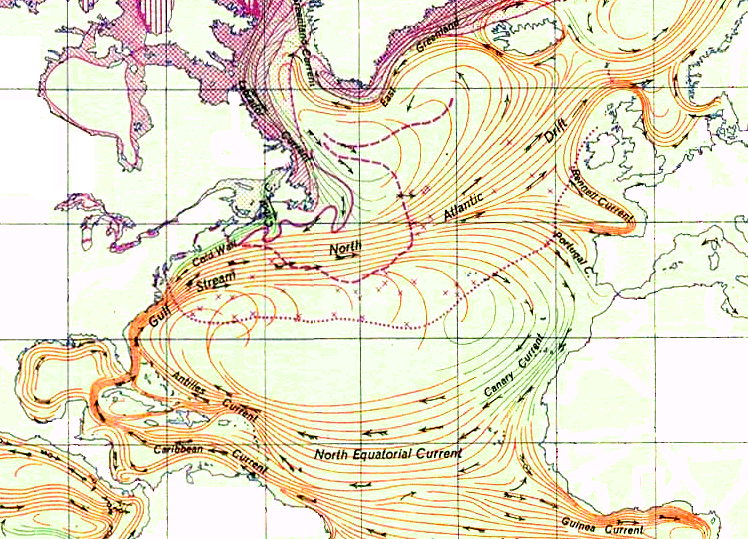
The Bermuda Triangle also encompasses the western extent of the Sargasso Sea. The currents of the North Atlantic Ocean circulate in a roughly oval pattern known as a gyre. Warm water flows up the East Coast in the Gulf Stream, across the North Atlantic to the coast of Purtugal, south along the Canary Current, and back across from Africa along the Equatorial Current to the Antilles Islands and the Caribbean. Right in the middle of all this, surrounding the 30th parallel, is a relatively calm area where thrives a species of seaweed known as sargassum, vast mats of which can accumulate on the surface. Christopher Columbus first reported these mats in his log, and to early sailing ships dense mats of sargassum could cause major troubles. If the wind is light, a sailing ship could become stranded in the sargassum for days or even weeks.

The confluence of these two factors no doubt fostered much superstition concerning the Bermuda Triangle. To date, no scientific evidence has been gathered to support the belief that the Triangle is anything other than a typical patch of sea -- to date, mind you. A lack of evidence does not mean that there is nothing unusual occurring there. But hypotheses concerning the location of the lost continent of Atlantis have little credibility in the deep waters and featureless ocean bottom of the Triangle, and space aliens will have to normalize diplomatic relations with the governments of the world before I will lend them any credence.

Of course, the Triangle will continue to inspire strange tales of the supernatural, and I welcome this.

Friday, November 23, 2012

Unions Are Nuclear Option

[Image courtesy of The Sweet Spot]

The image at left is from a blog by a mom named Aimee, who likes to do cool things with her husband and sons like putting firecrakers in Twinkies. It was the first image that came up when I did a Google image search for "exploding Twinkie" to jazz up this post. It's one of those "just because we can" kind of activities which keep life enjoyable.

Kind of ironic that I stumbled across this, because "just because we can" is exactly the kind of attitude that I believe drives a lot of modern unions in America, and one of Hostess' unions did the equivalent of the above. The Bakery, Confectionery, Tobacco Workers and Grain Millers International Union voted in September to reject a new contract which would cut salaries and benefits for all union workers at Hostess plants. The Teamsters approved the contract (barely), blaming executive mismanagement for the company's troubles but also expressing disappointment at the bakers' disapproval of the contract.

For a long, long time I have been extremely vocal about my disdain for unions. At my first job I was forced to join the UFCW, paying dues but receiving very few benefits because I was under eighteen. My father was a member of the UAW for thirty years, and, being the hard-working and ethical guy he is, suffered greatly at their hands, as most such people do in union shops. Unions drain a tremendous amount of resources from companies, force companies to retain some workers who have no business holding jobs at such compensation levels, and remove much-needed flexibility from workplaces due to job rules. I have seen the phrase "it's not in my job description" stymie many efforts by management at the various jobs I've held to keep their businesses profitable. The Teamsters have been doing this union thing for a little while now, so they understand the delicate balance between compensation and profitability, and spend quite a bit of time this month trying to talk the Hostess bakers down from their tree-stand. The fight isn't over yet, but I'm not hopeful. The exact same thing forced my first employer to close many of their locations, and my dad's former company went bankrupt, wiping out his pension.

As I've stated in several posts, I have a pretty good job. The compensation package I receive from The Company (known only as that in these posts -- they don't endorse my blog) makes me technically lower-middle class, and I work hard for it, as do most of my fellow associates. In a typical ten-hour night, I may switch jobs a dozen times or more, depending on where production efforts need to be focused. If I were a union worker, this would be impossible, because I would have a "job description" and work rules would be in place to prevent "disruptive" job-switching.

The simple fact is that business is rough these days. The Company does all of its business online, and the Internet never sleeps, so production demands can change literally in minutes. Without the kind of flexibility that I and many of my coworkers demonstrate, The Company would not be able to function. Thanks to other major retailers, The Company employs an abomination a strategy known as Just-in-Time inventory control (JIT), where just enough product is kept on hand to fulfill customer demand and is replenished dynamically, keeping inventory costs low to raise the marginal profit on sales. The net result is that our warehouses, and the production facilities of our suppliers, operate twenty-four hours a day to meet the ever-changing demand of our customers. The Company couldn't operate without workers like me, who are willing and able to switch from picking to packing to palletizing to loading and back again within minutes.  Imagine if restrictive work rules prevented me from doing that, if the union said, "Well, Annie's job description says 'forklift driver,' so you have to keep her on that forklift, even if you don't need another forklift driver right now." You won't get your Game of Thrones box set in two days like you wanted, because it's sitting on a shelf in the warehouse and we don't have enough pickers and I'm not allowed to go pick it.

Three years ago my job was gathering nuts and firewood, and the "warehouse" was a new-growth forest on the side of a mountain, so I consider myself fortunate to have a job. I'm triply fortunate because it's a job with a Company I like which suits my "Genius and Habits" so well. But there's eighteen thousand or so people who are not going to be so fortunate, losing their jobs right before the holiday season because five thousand of them want to buy their kids the new iCrap and believe they can't without the extra eight percent being cut from their contract. This is the dark side of democracy, where the majority suffer from the tyranny of the minority and vice versa, and unions tend to give validation to folks who want more than their fair share.

Which is why I would vote "no" if there was ever a card-check at the warehouse. Of course, that probably wouldn't be enough for my volatile personality. I would have to do something totally over the top like Sharpy a giant "DENIED" across the authorization card and staple it to the forehead of the union rep. But that's just me. More later.

Thursday, November 15, 2012

Lying Liars: The "Pump-and-Dump" Strategy

[Image courtesy of Wikipedia.com]

A year ago, Apple stocks (AAPL) were trading for under $400 per share. Starting in January, however, the stock began a meteoric rise, climbing and climbing on good news and rosy recommendations by fund managers, especially Goldman-Sachs. Late in September, however, AAPL peaked at around $705 per share and began a just as meteoric slide, dropping further and further until today, when it closed at $525.62

I can't say with absolute certainty that Goldman or anyone else has been dishonest in their recommendations, but I'm dead certain that AAPL investors have fallen victim to one of the oldest tricks in the stock market: the pump-and-dump. Many investors trust their stock brokers to make educated recommendations, believe, as I've said before, that these folks who trade stocks for a living are much smarter about such things than Joe Blow, and that there's no way on God's green Earth that they could ever be dishonest in any way. Well.

The pump-and-dump operates on lies. A prominent fund manager will buy a large position in a particular stock, then begin issuing recommendation after saccharin recommendation to their clients that "STFU is an awesome stock, they've got great fundamentals, awesome management team, strong market, blah blah blah" and push and push their clients to buy this stock. As demand rises, so does the price. Prices go up and up, and investors believe that they really did buy into a great thing, and start buying more to improve their own positions. Then, when the price hits a predetermined trigger, the fund manager will sell all or most of his shares, taking a huge profit and sending the stock into a tailspin. One to three months out, and all those investors who bought into their fund managers' lies are left holding nearly worthless pieces of virtual paper, weeping and gnashing their teeth over their ill fortune. The fund manager whistles his way to the BMW dealership and starts planning his next big scam.

There's no way that this scam can be made illegal. Certainly means exist to do so, but with the financial markets regulated entirely by once and future fund managers for major investment firms with deep pockets and loud lobbyists, no meaningful regulation will ever pass through Congress or the various agencies set up to deal with dishonesties such as the pump-and-dump. And in my opinion, there is little need for such regulation anyway, provided the average investor can become properly educated on exactly what constitutes a good stock buy, how and when to buy stocks, how to hold them, and how and when to sell them. The Motley Fool is an excellent resource for this, and you can teach yourself by reading as much as you can online. Charles Schwab has a comprehensive learning center, as do many investment firms large and small.

What you want to avoid at all costs is any talk of trusting anyone. What is it I always say? Oh, yes: "DON'T BELIEVE A WORD I SAY! Find out for yourself!" If your broker gives you a hot tip, research it. Examine the stock with a microscope, pick apart its price history, its earnings, dividends, capitalization, cash flows, legal issues, everything you can find. Then decide if it fits in with your investment goals.

The point is, stop trusting others blindly. The vast majority of humans out there are just like you, but there are predators hiding among them, just waiting for the naiive sheep to let down their guard. Trust must be earned and constantly validated, and knowledge is the best defense against those who prey on ignorance.

Mysterious Explosions


[Image courtesy of PennLive.com]

IN regards to the now-famous explosion that killed two people, destroyed three homes, and left 81 other homes uninhabitable, there has been much controversy swirling around the ensuing investigation.  It seems some people think that there is something more going on than a simple gas explosion, but I haven't really looked into it in any depth to determine whether the usual "government cover-up" conspiracy theory has wormed its way into the national discussion. Nor do I care to. The photo linked into this article (from PennLive.com) was from an explosion which occurred while I was living in Allentown. It occurred in a development located in a bend in the Little Lehigh across from the downtown, south of Ward Street. The blast completely leveled the house at 1341 St John Street, and the two homes on either side were condemned. Two brothers, Cesar Coto and Miguel Irizarry, were in the house at the time of the explosion. Coto was found under some boards by a neighbor, and Irizarry was found in the basement by rescuers. Both men were taken to Lehigh Valley Hospital and released the next day, having been treated for minor cuts and bruises.

http://www.pennlive.com/midstate/index.ssf/2008/11/allentown_house_is_destroyed_i.html

So, why am I telling you about this? Actually, I'm not 100% sure. The blast in Indiana recalled it to memory, and I wanted to mention it, but it's too lengthy for a Facebook or Twitter blurb. The case interested me because it was local, because the two brothers were relatively unharmed, and because at the time my best friend was at the height of her Heroes obsession. (I can't remember which of us first drew the parallel between the two brothers and Claire Bennet. For about a week after that I was like Mr. Glass, searching the Internet for more stories about miraculous survivals.)

But more intriguing than any of that was the mysterious circumstances which caused the blast. No gas leaks were discovered, and there was no evidence of methamphetamine manufacturing equipment or bomb-making supplies. In fact, the best explanation that investigators could produce was methane leaking up from an old landfill, which filled the house and caused the explosion. Methane is a colorless, odorless gas, which is supplied to homes by some gas companies for cooking and heating (propane and butane are also used). A mercaptan compound is added to provide the tell-tale "gas" odor, so that leaks can be detected by mere scent (the human nose can detect ethanethiol at concentrations of only 2.8 parts per billion). If there had been a leak from commercial gas supplies, someone in the neighborhood would have likely smelled it -- certainly the two men who were in the house at the time of the explosion. Fire investigators have conceded in numerous cases that people don't always smell gas before a gas explosion occurs. But if it were straight methane, nobody would have smelled anything beforehand.

It's possible there may be an ancient landfill under that land. It's also possible that the developers could have used unqualified fill material when they built the community. It's even possible there could have been a leak from a gas pocket under the city -- Allentown sits on a large limestone deposit overlaying Devonian shale formations, which could hold untapped reserves of  hydrocarbons. However, without detailed historical records or geological surveys, we may never know if there was a natural cause for the explosion. Hypotheses for unnatural causes would be too numerous to list.

I hope this article has made everyone think, and I also hope that you will keep an eye out for any other mysterious explosions in the news and post them in the comments. Remember that life is dangerous, and risk surrounds us at all times. You can take precautions, but like MAD Magazine once said: "You're never really 100% sure that there's not still a chunk of Skylab floating around up there with your name on it." Keep your eyes, ears and nose open, but don't succumb to stress. Life is too short to worry about it's end, which can come suddenly and with no warning whatsoever.

Tuesday, November 13, 2012

HAARPing On Chemspiracy

[Image courtesy of Wikipedia]

For several years now, there have been a number of conspiracy theories circulating which have gained quite a bit of traction, especially concerning the HAARP facility in Gakona, Alaska, and similar facilities in other countries, and the phenomenon known as "chemtrails," which are supposedly composed of a variety of compounds sprayed from commercial aircraft at the behest of the government. The supposed purpose of chemtrails is to poison the soil in certain areas of the US to prevent non-GMO crops from growing, and/or to facilitate HAARP signals to control the weather and/or cause earthquakes. Here's my take on these theories.

I'll start with HAARP, because it deals with topics about which I know quite a bit. The HAARP facility in Alaska is composed of two parts: a variety of radio-frequency receiving equipment; and a HF transmitter array capable of generating a 3.6 megawatt (MW) signal in the 2.8-10 megahertz (MHz) range. These frequencies fall within the 80- to 30-meter bands, which includes quite a lot of commercial line-of-sight communications, satellite data transmissions, RADAR, and "worldwide" bands -- so-called because they may be bounced off certain layers of the ionosphere to reach over the horizon, even as far as the other side of the world (Gordon West, WB6NOA, claims to have reached someone in Russia while load-testing a transmitter with a light bulb). Disruptions in the ionosphere can bend the radio waves in this band in strange and unforeseen ways, interfering with line-of-sight radio applications. The HAARP project exists because more data is needed to be able to predict and hopefully compensate for these disruptions, improving line-of-sight communications.

The conspiracy theorists speculate that HAARP can be used in one of two ways. First (and most plausible), the radio waves can be used to cause localized heating in the atmosphere, influencing weather formations. The other -- which I hesitate to mention because it is so fantastic -- is that the HF waves can be used to heat large areas of the ionosphere, raising the atmosphere. When the signal is removed, the heated area cools rapidly, slamming into the ground and triggering earthquakes. Chemtrails loaded with aluminum and barium compounds can supposedly be used to direct the signals to specific points.

Now, I could hardly be considered an expert, lacking any university degrees or practical experience in the fields of meteorology or seismology, but nobody can deny that I'm smarter than the average bear. Controlling the weather is a feat which is very, very far off. We can barely predict the weather now -- mucking around with Lorentz equations and grainy satellite images, when weather is influenced at both the macro and micro scales by every particle and molecule among quadrillions. If Earth manages to reach level 2 on the Kardashev scale, we might have access to that type of technology -- but not now. Additionally, the 2.8-10 MHz range of the HF array impacts the chemical makeup of the ionosphere, but not the troposphere, where all weather takes place.

Using the atmosphere to generate earthquakes is a neat idea, but basic thermodynamics would prevent it. Even if HAARP could generate the kind of power needed to heat large enough areas of the atmosphere -- I estimate about 10 million times HAARP's present 3.6 MW output -- locally and uniformly enough to impact fault lines, it would onyl be able to do so gradually -- and all that power would leach away just as gradually, not suddenly as stated in the theory. Simple application of critical thinking blows this theory out of the water. (Why, then, is the HAARP HF array so large? All radio applications require an antenna, and that antenna must be of a length equal to the wavelength of the target signal or one of its fundamentals. A 75-meter antenna at one-quarter of the wavelength -- the second fundamental -- would be over 60 feet long.) Additionally, see the above "additionally" note on weather modification. The energy of descending air from the ionosphere would be dissipated by the stratosphere and troposphere before it even reached the ground.

Chemtrails are a bit harder for me to debunk, not possessing the necessary equipment (an aircraft capable of  flying up to 12 miles altitude, atmospheric sampling setup, and a mass spectrometer) to analyze them, but I know a bit about fluid dynamics and combustion science. Commercial aircraft burn a fuel very similar to kerosene or diesel. The burning of hydrocarbon fuels releases, among other things, copious amounts of water vapor, which has a high density relative to the fuel from which it comes and consequently imparts a high degree of impulse (thrust) to the output of the jet engines. In the cooler layers of the upper atmosphere, this water vapor often condenses into a "contrail," which is the signature "jet trail" you will see streaming out of the tiny silver speck streaking across the sky. Water vapor leaves the jet nozzles at a very high pressure, which drops catastrophically upon contact with the cooler and relatively unpressurized air of the upper troposphere, triggering concdensation. Tiny specks of soot will also be among the exhaust products, providing more or fewer seeds for condensation, depending on the exact fuel mix and the condition of the engines. Depending on atmospheric conditions, i.e. barometric pressure, absolute humidity, and wind shear, those trails can persist for a very long time, even hours. In dense urban areas with major airports, the mingling of multiple persistent contrails can often give the appearance of grids or other patterns, especially if the conditions are right for persistent contrails. (For a more thorough debunking, see the Wikipedia article on the chemtrail conspiracy theory.)

Many of you know me as a highly credulous person. I am prepared to believe anything in the face of a robust, logical argument. I rule out nothing as impossible, having experienced many, many strange things in my lifetime. However, among my many experiences has been contact with people who suffer delusions, and the phenomenon known as folie à deux. Delusions happen when one part of the mind invents a fiction, and another part of the mind believes it as fact. These delusions arise from a wide variety of environmental stimuli and memories, and can appear quite real -- in some cases, more real than actual reality. (As a point of interest, I am a mad scientist responsible for implanting computer chips in the heads of dozens of people, according to one schizophrenic.) It may be a delusion itself, but I think I've become quite adept at distinguishing delusional statements from those repeated out of honest ignorance -- a phenomenon of pandemic proportions in today's society. Most folks are honest, and as such assume that everyone else is just as honest and would not lie to them. Also, most people seem to believe anything told to them by someone they perceive as more knowledgeable and/or intelligent than they are. (This is why I always say "DON'T BELIEVE A WORD I SAY! Verify it for yourself!") Therefore, a delusion can be passed from person to person in a geometric progression until we have a folie à plusieurs, and various government agencies are bombarded by calls from irate citizens demanding that they stop their nefarious activities at once.

Whatever the origin may be of any delusion, it remains exactly that -- a delusion, a fiction. A folie à deux, no matter how many people assert that it is fact, remains a shared fiction with little or no basis in actual fact. Do your own research, learn what you need to learn, and think critically about everything you see and hear. And at the end of the day, always remember that when God created this world, She filled it with many strange wonders and as yet unexplainable phenomena. Keep your mind open, but well-guarded.

Monday, November 12, 2012

Going John Galt

[Image courtesy of Wikipedia.com]

So, Obama has as good as pledged to veto any budget which does not raise taxes on people making over $250,000 per year. Sounds like all the more reason to not improve my situation.

I often mention that I drive a forklift for a living. Not a glamorous job, and actually much harder and more risky than most people think. (I spent ten hours each on Friday and Saturday on a center-rider, and I'm still sore.) And the fact is that my job entails much more than operating machinery. The supervisors at The Company (referenced as such to avoid any confusion about whether my employer endorses my comments -- which they don't) learned long ago that I am an intelligent and motivated worker, so they keep heaping more and more training on me. As a result, I know just about every job in the building -- and most of them require lifting and moving an average of approximately 32,000 pounds of product every night with my gloved hands. That takes a major toll on a body, especially one which has suffered as much physical punishment as mine has. It's a testament to the hardiness of my ancestors that I'm able to move at all when I come home.

In short, it's not a job which many people would prefer. It's physical, dirty, and it pays well below the $250,000 threshold set by Obama. With my intelligence and intuition, I could have been making way more than that by now. But I made the conscious decision a long time ago that I would not feed any more into the corrupt governmental system than I can possibly avoid. I live a reasonably comfortable life at my current income level, and while it would be nice to have more, it's not a necessity.

I foresee lots of people making this same decision if Obama's tax increase takes effect. Many people currently making $250,000 or more per year will find ways to reduce that, and many more will forego promotions, training and education which will push them above that threshold.  Indeed, several of my coworkers have indicated to me that they forego overtime to avoid being pushed into the next higher tax bracket. This is a phenomenon known as "going John Galt," and it has been underway for a while now.

For those of you who haven't read Atlas Shrugged, John Galt was a character in that book. He was a brilliant young man with an engineering degree from a major (fictional) university. He got a job at a manufacturing plant, where he began work on a revolutionary new type of motor which would draw electricity from the very air. But he abandoned the work after witnessing the devolution of society -- to an approximation of what we have today -- quit his job, and got a new job working as an unskilled laborer for a railroad. Does this sound familiar?

The "John Galt Effect" has been accelerating since 2007, and will continue to do so. As of February, Atlas Shrugged has sold 1.5 million copies since Obama was elected.

Sunday, November 4, 2012

Steel Cage Death Match 2012: Toohil v. Young

Well, what goes around comes around, I guess. Two years ago, the young and fresh Tarah Toohil defeated incumbent Speaker of the House Todd Eachus to claim the 116th district seat. Toohil is a lawyer from the Hazleton area who has the backing of the Tea Party. Eachus was an establisment career politician who, while doing a bit of good in response to the kids-for-cash scandal, funneled millions in federal pork to his hometown area of Scranton. I was very glad to see Toohil triumph.

This year, it's Toohil as the incumbent, facing tough opposition from Democratic candidate Ransom Young. And by tough, I mean muddy. Now, I do have to give Young credit. Back in April, he and Toohil made an agreement that they would keep their competing campaigns clean, and Young almost made it to the end. A couple weeks ago, photos came out depicting Toohil in potentially embarrassing positions (possibly smoking pot but definitely riding a camel). At first, Young and Pennsylvania Democrats denounced the obvious attacks as "dirty, nasty politics at its worst." But in their debate this past Wednesday, Young capitalized on the controversy, calling Toohil's integrity into question even though she was totally up front and honest about everything.

I'll be completely honest -- Ransom Young pisses me off. He's yet another career politician who's big on image and rather short on the issues. His only legitimate claim to fitness for government is his blue-collar cred, being a farm owner and former small-business owner. He has quite a few good ideas -- closing the Delaware loophole for corporations, promoting tech jobs in the Hazleton area, and increasing severance taxes for natural gas drillers. However, like most good ideas, these all have their caveats. For one, closing tax loopholes will do more to discourage corporations from doing business in Pennsylvania, rather than increasing tax revenues.

For another, raising the bar on skill levels for area employment will have a detrimental effect on Hazleton. This city was built on coal and coal mining, and our blue collars are pretty much dyed in the wool. If CAN DO and other development companies try to attract more technology and other white-collar jobs to the area, the net result will be yuppies driving in from New York and the Poconos to take those jobs -- and space which could have been used for semi-skilled and skilled labor, such as manufacturing and warehousing, which suits the skill-set of the average resident perfectly, will be taken. As a data-analyst-turned-forklift-driver, I have very strong feelings about this. Let's be honest -- Hazleton is poor, economically speaking. Most folks here can't afford to send their kids through six years of college to get jobs they'll hate anyway. If you're going to hate your job, at least let it be one where you're making fifteen dollars an hour WITHOUT being tens of thousands in debt on student loans. (From one who knows.) The best strategy here is to offer incentives to companies who have manufacturing and logistics divisions and promote training programs for workers to make them more attractive for such positions. The job skills I've learned since moving to Hazleton will probably carry me through for the rest of my life.

Now, what about Toohil? The only thing she's done to piss me off was voting in favor of a law allowing the Commonwealth to override local zoning rulings unfavorable to natural gas drilling. Bad idea. Fortunately, the law was overturned. But on the other hand, she's done wonders on the MinSec issue. I've blogged before about this, so I'll not repeat myself. Toohil's ideas on employment fall more-or-less in line with what I detailed above. She helped to eliminate an unaccountable cash-assistance program (detailed elsewhere) which was costing Pennsylvanians millions every year. She has also embarked on a number of personal missions to educate Commonwealth residents on various legal issues.

One more thing I like about Toohil is something which has caused far more and more vociferous controversy, not only for her but for many, many people over several centuries: she is a lawyer. Many scholars have noted the deleterious effect lawyers have had both on legislation and on judiciary procedure, producing "legalese," statutory construction, and rigid behavioral forms nearly incomprehensible to the average person. However, lawyers have the unenviable task of interpreting the law and explaining it to others, just as historians analyze the past and teach the various levels of significance to people. Having a lawyer representing me in the assembly is of immense comfort, having spent man-months of my time examining and interpreting law for my own purposes. It is dull and tedious work, just like data analysis or warehousing, but necessary. Make of that what you will, but I prefer to have specialists handling specialized tasks.

So, my closing statements to the candidates: Young, reclaim your integrity and keep your 2014 campaign clean to the end. Toohil, good on ya, but respect individual and municipal rights in your next term.

Thursday, October 18, 2012

Steel Cage Death Match 2012 Part Zero: Race to the Bottom

http://standardspeaker.com/news/toohil-opposition-call-release-of-photos-dirty-politics-1.1389876

Once again, I'm way behind on my research for this election season, so I apologize for leaving you all hanging with my last post. But today I saw an article in the paper which greatly disturbed me: Tarah Toohil Smoked Pot in College.

Tarah Toohil is my representative in the state Assembly. She's a Republican, believes strongly in job creation and controlling the cost of government, votes generally on her party line but is quite vocal about her opinions on most issues. She was also born in a year that I remember, and makes me feel old. And she may have kissed a girl and liked it.

A video appeared on YouTube showing a photo montage of Toohil engaged in a number of "questionable" activities, including (but not limited to) possibly smoking marijuana and kissing another girl. Oh horrors. How many of you smoked pot at least once in college? Probably a majority of you. Hell, even I smoked pot in college, and I never even went to college! I would also wager that an increasing number of young women have engaged in a more-than-friendly kiss with another young women -- still a minority, but growing. Women are more comfortable with their sexuality than ever before, even Pennsylvanians, so expect to see more of it.

As we move through life, we make decisions which affect the outcomes of our lives as well as shaping our personalities. The best decisions are those based on careful deliberation and consultation with sources of wisdom. Most people I know did not do so before the age of 25 -- and a growing plurality who are still muddling their way through life on some issues in exactly the same fashion. I didn't consider myself fully an adult until I was 33, and I still have growing to do. We all accumulate wisdom as we live and decide and act, so it logically follows that when we are young we lack wisdom and sometimes make bad decisions. Some of those decisions -- Tarah Toohil's decision to try pot in college, for example -- do not reflect the character of a person later in life. Even the Luzerne County Democratic Party, whose candidate Ransom Young is opposing Toohil this fall, affirmed this, calling the video "dirty, nasty politics at its worst."

Does all of this sound familiar? Herman Cain was drummed out of the Republican primary race early this spring over allegations of sexual misconduct from decades previously. Bill Clinton faced allegations during his candidacy of smoking pot in college. And yes, even our current President smoked pot in high school, according to sources (putting the "pot" in "POTUS").

When I was little, I would pick up any random reptile which came across my path. I now know that it is unwise to do so. When I was in my twenties, I smoked marijuana a grand total of four times. I gave up trying because it made me think in ways which made me feel uncomfortable afterward. The same goes for excessive drinking, chain smoking, and overeating -- all unwise behaviors in which I engaged at some point and have since stopped.

My point is that unwisdom early in life does not necessarily reflect a lack of wisdom later. The article linked at the top of this page includes statements which show that I am far from being the only person who thinks so. Politics in America need to grow up if we are to craft a better future for our children.

Saturday, September 29, 2012

Steel Cage Death Match 2012 -- US Senate

[Image courtesy TheHotJoints.com]

The focus this election year is, as always, on the White House. But there is way more to government than 1600 Pennsylvania Avenue. Do you even know who your state senator is? I had to look mine up (John Yudichak). How about who's running for district justice? The contests peripheral to the presidential race are actually more important.    Control of the White House means little if the Senate and/or House are against you. And the state posts determine how your local situation will play out, as well as determining how much control the federal government has over your state.

I've started my election research late, but I want to share with you the results. I'll detail the candidates for the various positions, as well as give a run-down on the platforms for the major political parties.

The districts for Hazleton are as follows:

  • US House of Representatives: 11th District
  • State Senate: 14th District
  • State House: 116th District

US Senate

One of Pennsylvania's Senate seats is up for election this year, currently held by Robert P. Casey, a Democrat. His challengers are Republican Tom Smith and Libertarian Rayburn Smith. 

Tom Smith is an exciting candidate. He's the son of a farmer, a former coal miner, and former coal company owner. He is a true rags-to-riches American success story, unlike some candidates in other races who make the same claim.   His stance on issues is better said by his campaign page, but here's the highlights I find exciting. He supports a flat income tax, reducing federal spending to 20% of GDP, simplifying business regulation, and  saving Social Security. He supports a balanced-budget amendment to the Constitution, and suspending pay to Congress in the event that they do not pass a budget. He supports adequate defense spending. And, most exciting of all, he supports shifting alternate energy investment to the private sector, and ending government spending in this area (Solyndra, anyone?) while saving the nation's oil and coal industries. I find this exciting because I dream of a day when all of our energy needs are met by wind and solar, but live in a world that currently runs on fossil fuels. The realist in me likes spending 3.36 cents per kilowatt-hour, and can't see burdensome regulation and taxation having any result except to raise my energy bills.

Incumbent Bob Casey is only slightly less exciting than his Republican challenger. He's taken tough stances on issues such as the Farm Bill, trade with China, CHIP, and Medicare. More information on his stance is available at his campaign page.

Libertarian challenger Rayburn Smith is quite a bit less exciting than the other two. I couldn't find any information on him at all -- no press releases, no campaign page, no contact information, and no news stories outside of those pointing out the fact that his name is also Smith. Seriously, I don't think the Libertarians are even trying this year. Definitely not bringing their A game that was evident when Ralph Nader was in the hunt.

I will continue this dissertation as my research progresses. The next post on Steel Cage Death Match 2012 will cover Lou Barletta and Gene Stilp.

Wednesday, September 26, 2012

Gay Tyrants

http://www.washingtontimes.com/news/2012/sep/25/homosexuals-in-the-military-demand-special-privile/

I commented briefly on this article on a share from Facebook, but this is a subject about which I know a great deal, and about which I feel quite passionate.

For a long time now I have followed a general principle of "don't ask, don't tell." Not the official military policy -- I don't think that someone's sexual preference is anyone's business, nor is it worthy of any special attention, either positive or negative. The same goes for gender identity and expression. Naturally, sexual orientation and gender identity variances are completely separate issues, but they share some of the same societal issues, such as stigmatization. It's not normal, statistically speaking, for someone to fall outside of tradtitonal gender identity. The Transgender Law & Policy Institute estimates that between two and five percent of the general population have some sort of gender identity issue. That's at maximum about 350 million people worldwide -- not a large number overall. However, for those who do suffer, it is a major issue.  There is an ongoing debate in scientific circles over whether a person's gender identity is influenced more by biological or societal factors. That discussion is outside the scope of this post, and I've written more on the subject elsewhere. The Internet holds a vast resource of information on gender variance, and I urge you to research the subject for yourself if you wish to become more knowledgeable. For now, I will focus on the issues I encountered after I completed my transition to living full-time as a woman.

I don't "pass" well as a woman, possessing a male-pattern mesomorph physique and a more or less male facial configuration. The only clues people really get to my preferred gender are my voice, my style of dress, my modest-sized breasts, and the lack of visible "batch." As a result, folks are not quite sure what to make of me. Most, thankfully, say nothing. There are a few curious souls who will ask questions, and I always answer them truthfully. Curiosity should always be rewarded with knowledge. However, I never go out of my way to express the fact that I am transgendered. I leave others the option of ignoring it.

But then there are a very few who go out of their way to make it clear just how "cool" they are with my gender variance. This type of behavior always makes me feel uncomfortable. I am completely comfortable with my own identity, and depend not at all upon the opinions of others. As a result, I greet any special treatment -- whether positive or negative -- coldly. The only special treatment for which I have ever asked has been to not be forced to use the men's room at work. Fortunately, only at one place of employment have I suffered that indignity. Out of respect for those who lack understanding, I generally avoid communal lavatories, such as public restrooms, preferring single-occupant facilities. This is not always an option, but I make the effort, because I understand that not all people are as comfortable with the idea of gender variance as I am.

It is because I have this attitude that I am upset about the heavy-handed manner in which acceptance of homosexuality has been forced upon the military establishment in particular, and society in general.  Any person's sexual preference should be no one's business except that person and any sexual partners they may have.

I would like to propose the following policy changes:

  1. Reinstate the "don't ask, don't tell" policy, but modify it so that mere knowledge of a person's sexual orientation is not grounds for dismissal. If such knowledge is revealed, either accidentally or purposefully, and that knowledge creates any disruption within the unit to which the individual is assigned, the person should be eligible for reassignment similar to any other guidelines involving intraunit conflict. Sexual orientation should be treated exactly the same as religious preference, choice of reading materials, political views, etc.
  2. Any rules or guidelines governing romantic or sexual behavior between men and women within military structures should be applied in exactly the same manner to homosexuals.
  3. Any rules or guidelines governing other behaviors of military personnel should also be applied in exactly the same manner and penalties applied at exactly the same level of severity to all persons, regardless of any factors.
The point I'm trying to make is that homosexuals should not be treated any differently than heterosexuals. My favorite saying, generally in regards to public speaking but equally applicable to all aspects of social interaction, is "everyone has to sit on the can sooner or later." Another: "...to all the men upon this earth death cometh soon or late." And, more importantly:
We hold these truths to be self-evident, that all men are created equal, that they are endowed by their Creator with certain unalienable rights, that among these are life, liberty and the pursuit of happiness. 
 The course of action being pursued by the pro-gay lobby violates the unalienable rights of their opponents. The forced acceptance of homosexuality we are now seeing is in no way different from the forced oppression historically suffered by homosexuals. It is the same philosophy, enacted in opposite ways: tyranny.  Opposition to tyranny is what formed these united States, and opposition to tyranny is what drives my every thought, word and action, as it drove our Founding Fathers. Colonel Crews has correctly pointed out the tyranny currently being espoused by the pro-gay lobby, and I applaud his forthrightness in regards to the subject. It is only through such free speech that tyranny, in ALL its forms, can be defeated.

Saturday, September 15, 2012

Our Idols vs. Their Idols

There was a time when I shunned all discussions about religion and faith. The reason for this is that my own spiritual worldview was still evolving, and I didn't want any outside influences coloring my understanding of God and my connection to Her. (I say "Her" because God usually appears to me in the image of a young and yet old woman.) My spirituality is still evolving, and probably will be for the rest of my life, but I've reached a point where I've discovered enough that I feel comfortable enough to pass along the insights I have gained in the process.

Recently, I began a comparative study among world religions, looking for the common threads running through each system which can tie all of humanity together. The first result of that was my post, "War Is Not Normal for the Human Condition." I've spent most of my time since collating the information I gleaned, focussing on the Abrahamic religions which form the spiritual basis for the majority of humanity. And I've discovered some pretty interesting and, I hope, eye-opening co-relations.

The primary aspect of all the Abrahamic religions -- and indeed of most religions across the world -- is the inaccessibility of God. The concept of God as an omnipresent, omnipotent, omniscient being is an incredibly difficult concept around which to wrap one's mind. Imagine having the ability to hear the thoughts of every person on Earth simultaneously, to see and alter, if desired, the behavior of every particle of which the universe consists. The average human worldview consists primarily of what is immediately in the person's field of vision with thoughts extending to places, individuals and events within that person's field of influence and into the immediate future. In that view, God is infinitely larger than any one of us. To bridge that gap, early religious adherents devised idols as "focus items" by which they could focus on one or several aspects of God and thus achieve some limited connection between the human soul and divinity. The tribal tendencies of humans drew together people who had similar conceptions of God and, by extension, separated them from people having different views. 

Strife arose almost immediately, as the limited Godviews vied for supremacy as "the one true faith," or the "actual" concept of God. To a great extend, however, each Godview is correct, even if they seem to be contradictory. (Rule #1: Contradictions do not exist.) Think of yourself and your various moods. I, for example, have a tendency to express my love freely, which leads some to assume that I am a kind person. I also have a strong sense of justice, leading others to believe that I am cruel. These two views seem to contradict one another, yet they are merely different aspects of my personality expressed in different ways to different people in a diversity of situations.  And the worldview of the person witnessing my personality expressions will color their perception of my intentions -- a stable person will see one of my expressions of love and view me as supportive, while an insecure person may assume that I am weak and exploitable.  All these views of me are correct to an extent, but each assumption is made in the absence of evidence of all sides of my personality which make up the totality of my being. In this way, all people of faith have a correct but incomplete perception of God.

Because of this limitation on our ability to grasp the full extent of God, direct messages from God tend to take the form of prophesies. Throughout history, there have existed individuals who have been able to form a more complete conceptualization of God and thus make a greater connection to divinity.  Examples of such prophets include Noah, Moses, MuhammadBahá'u'lláh, Joseph Smith, and Buddah, among others. There are some who regard these persons as "Ascended Masters," and herein lies the difficulty, and the overall topic of this post. Each of the individuals I have mentioned, and many others, have achieved a level of veneration among some admirers that they have been elevated to the level of divinity Itself, and thus become perceived as sacrosanct and worthy of worship as gods themselves. There is a term for this behavior: idolatry. Idolatry has been commonly misunderstood as the worship of physical objects as gods. In actual fact, people and concepts can also constitute idols if they become the focus of worship in place of God. Idolatry is a natural reaction by the limited human worldview to bridge the perceived gap between God and the worshiper, "but if from thence thou shalt seek the LORD thy God, thou shalt find him, if thou seek him with all thy heart and with all thy soul." (Deuteronomy 4:29) 

My point is that each of us is capable of making an individual connection with God, albeit in a limited fashion. If you make a true effort, with no evasion and stripped of all preconceptions, then you will truly know God in all of His/Her aspects. No priesthood is necessary, no other limited human to tell you what to expect, no established religion to color your perceptions of divinity. You can become a religion of one, or of two, you and God. There is no need for competition between dueling idols for supremacy in men's hearts. God speaks to each of us, seeks a connection with every individual on Earth, and in this way we are all one, all equal, all worthy of basic human respect.


As a side note, this is why I adhere to the Wicca faith more strongly than any other -- there are no idols. Some witches use objects on their altars as representations of one or more aspects of God, but those are merely focus objects, used as gateways to make the connection between the worshiper and God. (Some of us need help with that.) I'm sure there are some witches who would venerate the likes of Aleistair Crowley, Gerald Gardner, Scott Cunningham, or Raymond Buckland, but the majority with whom I've come into contact regard them merely as men, fellow travelers upon this Earth seeking connection to divinity and willing to pass along the wisdom they have accumulated. May they ever be regarded as such in the minds of witches everywhere. 

Thursday, September 13, 2012

Humans Unite Against Apes in Libya

[Photo courtesy of Imgur.com]

My previous posts ranting and raving about hairless apes who have the audacity to call themselves human are now more relevant than ever. The link posted above contained this photo among others showing what true Muslims think. In a previous post, I claimed that war is not normal for the human condition. And seeing Libyans holding up signs which say things like "Sorry People of America this is not the Behavior of our Islam and Prophet" and "Chris Stevens Was a Friend to All Libyans" proves to me that there still exists at least a plurality of non-radicalized Muslims who share my feelings on violence.


Please Stop Voting For Monkeys

Speaking of people of whom I am ashamed:

Romney criticised for remarks on Libya attack

Mr. Romney, Mr. Obama, do you actually presume to call yourselves adults? You sound more like you're running for class president than POTUS. The most important seat in the nation should be occupied by someone mature in their thinking, moderate in their views, diplomatic in their dealings with the other branches of government, and critical in their analysis of situations. Thus far in this election season, neither of you has shown anything remotely resembling those qualifications. Quite the opposite, in fact. You are both knee-jerk one-upsmen, snapping at every little opportunity to denigrate your opponent in hopes that everyone will hate you less than him.

My first real awareness of campaign mud-slinging came in 1988, when my tender young ears were treated to the invective flung from the television set by George H.W. Bush and Michael Dukakis. It was in those months that I first began to lose faith in the American political establishment, and that erosion continues with each successive biennial election season. I am reminded painfully of chimpanzees flinging their own feces at rival troops. Perhaps "mud-slinging" is not the proper term.

So, once again I am reduced to vituperating supposedly human beings, reminding them that they are NOT animals but sentient, sapient beings capable of far greater and more noble sentiments than the poop they are throwing not only at each other but at every American. 

Mr. Romney, Mr. Obama, you are degrading us all with your primate-house antics. Show us your big brains, not your red butts.


Do It Yourself!

[Image courtesy of the Villains Wiki]

There are a lot of villains out there. Right here in Hazleton, we're still feeling the effects of the villainous operators of Municipal Energy Managers, who were contracted to maintain the city's streetlights but instead pocketed the money. The last time I checked in on the situation, there were nearly a dozen municipalities in eastern Pennsylvania who have either ended contracts with MEM or have filed suit against its owners. And of course, there was that to-do with Bernie Madoff, and legions of other schemers seeking to part fools from their money.

Kinda splashy, I know, throwing Zorg's evil face at you right off the bat. But Zorg's epiphany -- which came too late -- was that "if you want something done, do it yourself." There have been a few scandals recently involving hedge fund managers and ratings agencies, two entity classes which I view with the same scorn as the blattodea still sharing living space with me. First of all, hedging is something gamblers do. I hate gambling. Rule #3: Never leave anything to chance. Second, relying on someone else to tell you what to do with your money is just plain foolish. And giving someone else your money to manage for you is even dumber.

It can be argued that the US dollar is a legal fiction, that it doesn't really exist, that it's backed by nothing and therefore has no real value. Yet, as I write this, I'm eating ice cream I bought using US dollars I earned doing useful work for my employer (who I call simply The Company, because my opinions do not necessarily reflect theirs). So those dollars have some sort of value to me, The Company, the grocery store where I bought the ice cream, the ice cream manufacturer, and the dairy farmer. And all five of us want those dollars to go as far as possible to keep our operations afloat, and that sometimes means investing. Of course, each of us invests their money in a different way. The dairy farmer invests in feed, milking machinery, and veterinary care. The ice cream plant invests in machinery and sanitation supplies. The grocery store invests in freezers. The Company throws nearly all of its profits into growing its business (much to the chagrin of stock analysts -- muah-hahahahahah!). And I invest in tools and equipment to reduce my electrical dependency.

All this investing activity involves research. If you go into your local department store looking for a coffee maker, you might just grab the cheapest one. But I can guarantee you it won't last the year. A little bit of research will point you to a better coffee maker, one that will last five years and has a few extra features like a timer or an energy-saving mode or a built-in bean grinder. You'll pay a little more, and yes, your "research" may consist merely of reading the boxes of the various coffee makers on display, but you'll get something that will satisfy you so much more than just grabbing whatever junk you happen to come across first. I know for a fact that a lot of people take the same approaches to buying a car, ending up with a car for the next decade -- or the next six months. You can't just buy any random car. And you certainly won't give your money to someone and say, "Go get me a car." Who knows what you'll end up with?

The same goes for investing in stocks and bonds. You need to carefully research the company behind the stock you want to buy, and determine for yourself whether it is a good buy or not. Give your money to a fund manager, and God only knows what you'll end up owning -- or not owning. Many of you out there are confused by the intricate systems of investing, what with all the market quotes and analysts opinions and options and whatnot. But you can learn. A good place to start is The Motley Fool, who gave me my first leg up in investing parlance and procedure. And I suggest you do so, instead of letting the next Bernie Madoff get his hands on your hard-earned dollars.

Don't get blown up in the next fund scandal. Do your homework. Invest wisely. And put your dividends to good use.